
On Friday, 5 December 2025, I facilitated a learning café on the success factors of implementing learning technology during Online Educa in Berlin. This blog post provides an impression of the setup and key conclusions. For the benefit of the participants, the impression is in English.
 This workshop introduced a structured way to learn from practical experiences with EdTech implementation. The main aim was to help participants identify success factors that can support future decisions in their own organisations. At the start I outlined a clear challenge: a new generation of EdTech tools is emerging, and we can learn to understand what worked well in earlier implementations. The workshop therefore focused on concrete lessons drawn from real cases, with attention to elements that made those implementations effective.
The central method used in the session was the Story Festival approach, which encourages participants to share and analyse their own experiences. This method is based on the idea that professionals often learn the most from each other’s stories. The purpose was to exchange examples of successful EdTech implementation and to identify what made these examples work in practice. The emphasis was not on general principles, but on specific actions, decisions or conditions that had contributed to positive outcomes.
The workshop design consisted of several structured steps. First, each participant prepared an individual success story. They were asked to recall a situation in which an EdTech implementation—such as an LMS or another large IT project—went unexpectedly well, or where a difficult process ultimately became a success. Participants reflected on the context, their own actions and the results. They wrote down their story using a provided format. This ensured a consistent level of detail and helped participants focus on aspects that could reveal success factors.
Next, the group selected a moderator. The moderator coordinated the process, monitored the time, encouraged interaction and summarised the outcomes. This step supported a structured conversation and ensured that each participant could contribute. The moderator would later present the group’s main conclusion during the plenary part of the workshop.
Participants then shared their stories in small groups. Each person briefly explained their case, while others listened and asked clarifying questions. After each story, participants individually identified success factors from the narrative. A second part of the format was used to guide this analysis, helping participants to articulate what they saw as the specific elements that contributed to success.
In the following step, groups clustered the identified success factors. They compared similarities and differences between their findings and formulated conclusions on a third part of the format. The task was to reach a shared insight into what their stories collectively suggested about successful EdTech implementation. Each group was then asked to select one overarching conclusion and document it using a separate worksheet. This focused the discussion on the most relevant patterns that emerged from the stories.
The plenary section allowed all groups to share their key conclusions. These final minutes of the workshop brought together the main themes from across the room.The main outcomes were:
A first recurring point concerned clarity of purpose. Who is the primary target group, what change is intended and why should educators or learners engage? Making the why explicit, what’s in it for the eomployee, alongside inviting learners to contribute to the creation of materials, helps build a sense of ownership and curiosity. These were framed as crucial drivers of sustainable innovation, rather than optional extras.
Conditions for implementation success were described in organisational rather than technical terms. Visible communication of successes—even small steps—helps maintain morale and shared direction. Creating a sense of urgency (for example around accessibility or workload pressure) can support action, provided it is not experienced as pressure but as a shared responsibility. Leadership was repeatedly identified as decisive: not only in approving budgets but in shaping vision, safeguarding agreements and enabling experimentation. Leadership by actions, not only words. An agile approach, with pilot phases, continuous feedback and iteration, was considered more realistic than expecting linear rollout.
Communication emerged as a cultural and relational issue, not just a logistical one. Messages need to reflect institutional language, tone and context if they are to resonate at every level. Professional development must be linked to practical digital support, including self-assessment so that staff understand their current level of digital competence and what progress looks like. Data was discussed as a tool for collective learning rather than institutional control, with KPIs used to support improvement rather than compliance.
The final message was pragmatic: start where the energy is. Work with intrinsically motivated staff, recognise constructive feedback and avoid letting scepticism dominate the narrative. When pedagogy and technology are integrated, collaboration is encouraged and results are made visible, institutions create the conditions under which EdTech 2.0 can become embedded rather than episodic.
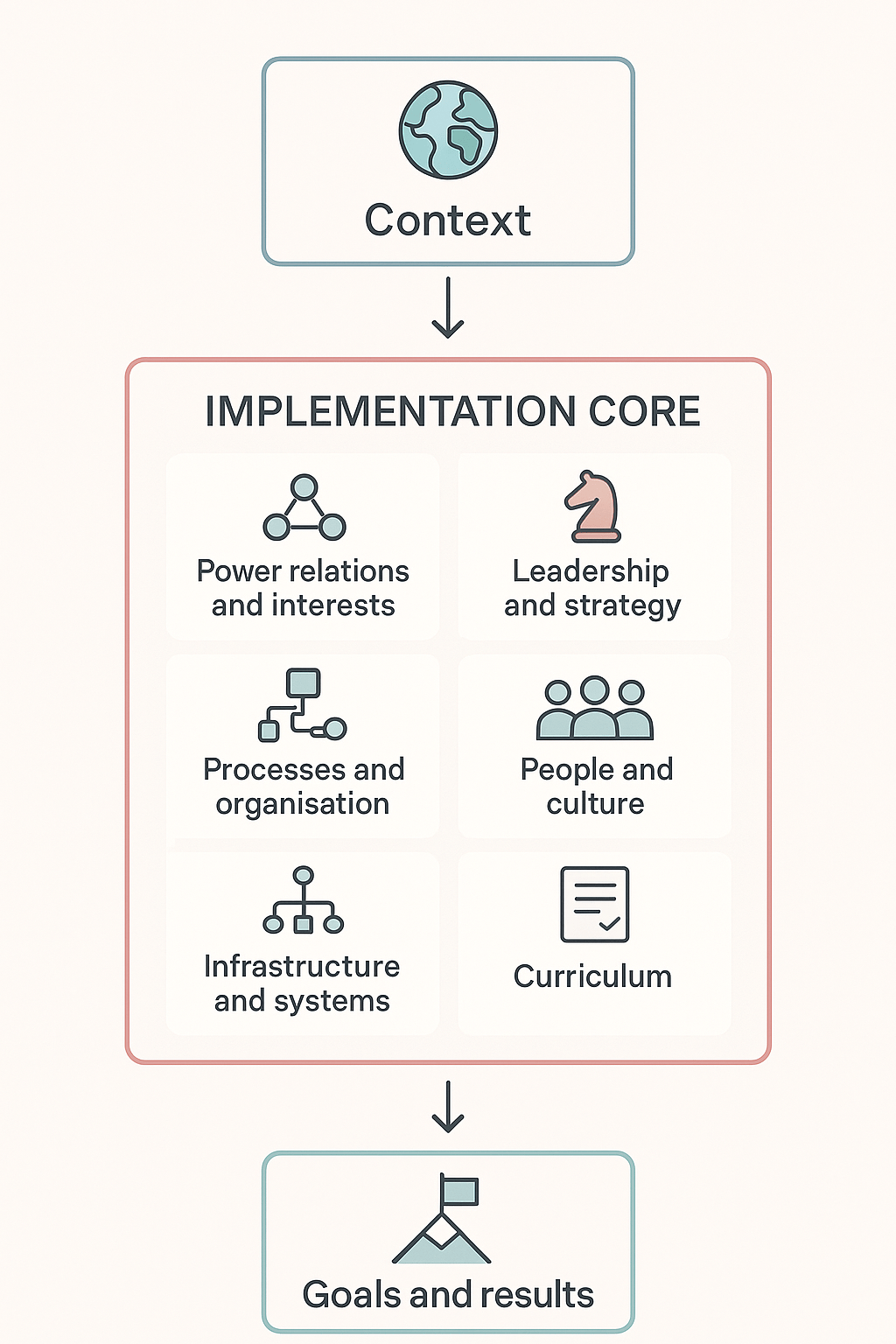
In addition I presented a general framework that can support reflection on EdTech implementation (see the picture above). This framework highlightes several domains within an ‘implementation core’, including leadership and strategy, processes and organisation, infrastructure and systems, curriculum, power relations and culture. You can fit the mail outcomes in this framework. I used this framework to reflect on the main conclusions.
Geef een reactie